Drosophila melanogaster · male CNS v1.0 · CC-BY
Raise a real fly's brain.
165,122 neurons, traced one by one from an actual fruit fly with an electron microscope. Not a character. Not a model of a fly. The wiring of a real one — and it is yours to bring up.
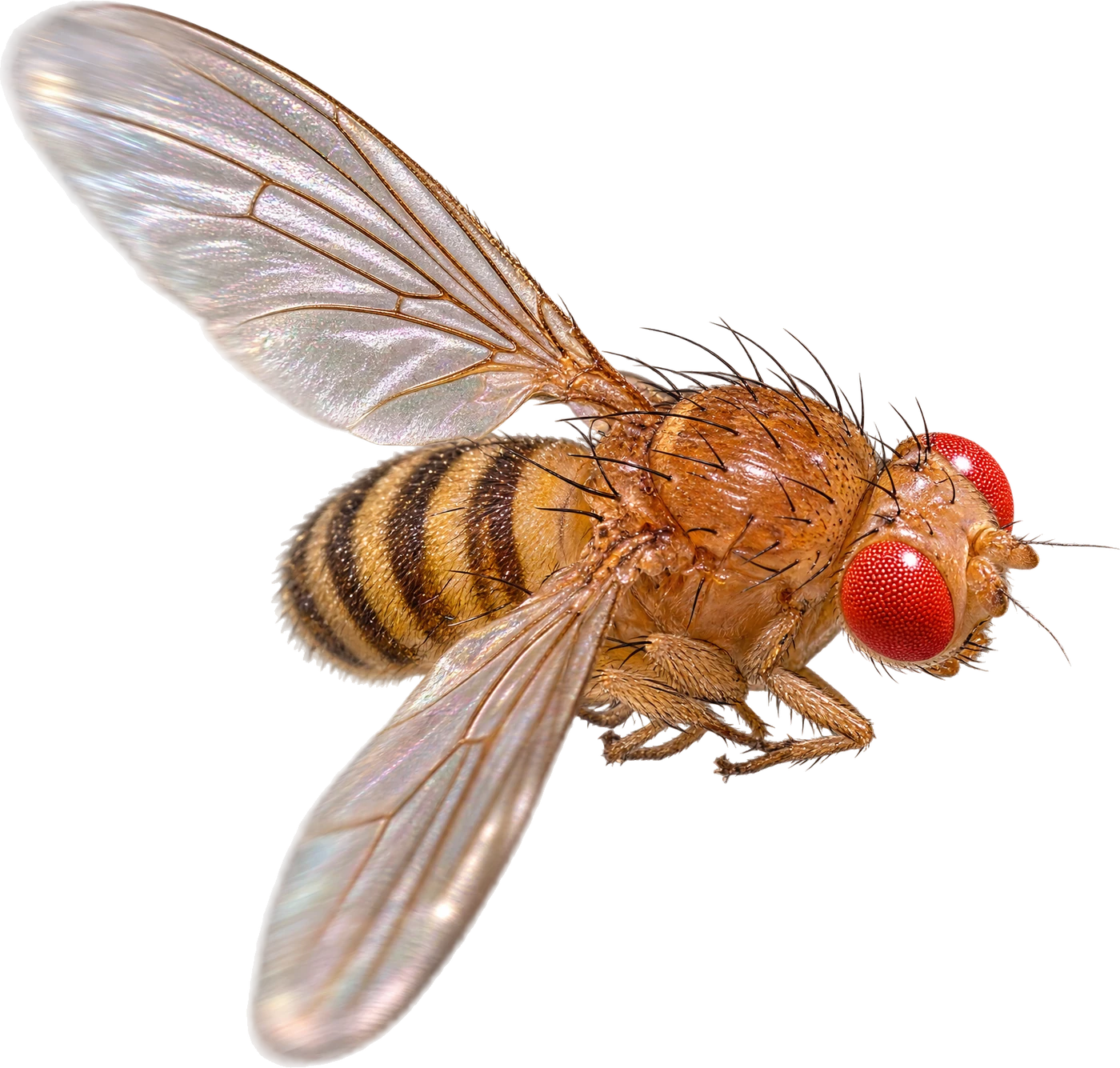
- optic lobe
- central brain
- mushroom body
- nerve cord

your fly, right now
It is walking around in there.
Everything on this screen is read out of a running simulation on a server: where it is, what it is doing, and how much of its brain you have changed. Nothing is animated to look busier than the fly actually is.
- It sees the arena through 892 hex columns
- It smells the fruit with 2,635 receptor neurons
- It walks on DNa01, steers on DNa02, stops on DNp09
connect a wallet to meet your fly
press G or B — but only when it is smelling something
the farm
Every fly here was carved by somebody.
A fly is 44,042 numbers and nothing else. Nobody can buy a better one, and nobody can fake one: what you see below is how many presses actually landed on a living Kenyon cell.
loading the farm…
how it learns
Both buttons weaken it. That is how a fly learns.
This is the part everyone gets backwards, us included at first. Learning in a fruit fly is subtraction. Its mushroom body starts out able to drive every response it has, and experience carves away the ones that did not pay off. Nothing is strengthened, because that is not what the measured rule does.
Which side is which was not decided by us. It is read out of the connectome, by comparing how much dopamine each MBON gets from the reward pathway against the punishment pathway. That split lands where the literature puts it — and it is lopsided, so scolding your fly is about half as powerful as praising it. That asymmetry is in the measurement, not in our code.
And it forgets. Every weight drifts back towards where it started, slowly, forever. A fly you stop raising relaxes back into an ordinary one.
specimen plate
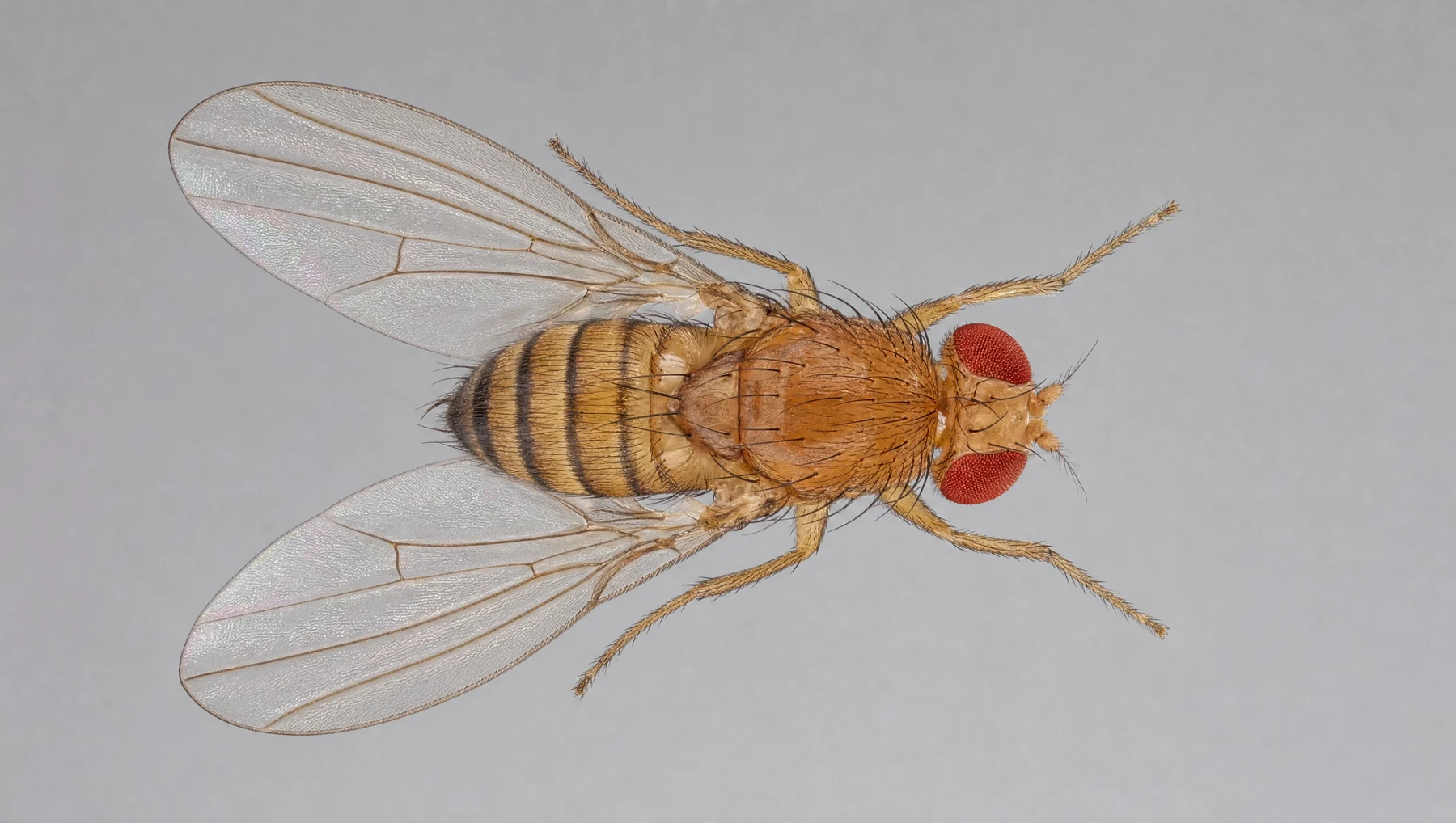
Every part of it is a real part.

- 892hex columns behind the eye — a view about 30 pixels across. It cannot read; text is texture to it.
- 2,635olfactory receptor neurons, 53 types. This is what reaches the mushroom body — the nose does the learning, not the eye.
- 4descending neurons drive the body: DNa02 steers by left/right asymmetry, DNa01 walks, MDN reverses, DNp09 halts.
- 44,042Kenyon-cell-to-MBON synapses — the only weights that change, and only ever downward.
stated plainly
Is any of this real?
- The wiring. 165,122 neurons and 10,228,000 connections, every one traced from electron microscope images of one male Drosophila melanogaster. Published by HHMI Janelia FlyEM, the Cambridge Connectomics Group and Google Research, CC-BY. We download it and you can too.
- The eye. 892 retinotopic hex columns, the ones the dataset assigns.
- The nose. 2,635 olfactory receptor neurons across 53 receptor types.
- The legs. DNa02, DNa01, MDN and DNp09 — the descending neurons a fly actually walks with.
- The learning site and its direction. Kenyon cell to MBON, under dopamine, depression only.
- It is not alive and not conscious. A connectome is a map, not a mind. The activity is simulated.
- The reward. A fly is rewarded by sugar, not by you pressing a button. That swap is a choice a person made.
- The world and the smells. Ours. We drew the box it walks in.
- Two constants are ours. The published weights put this network in an avalanche, so we scale them by 0.45; and we let APL and DPM release continuously instead of spiking, because they are non-spiking neurons in the animal. Both are in the repo with the measurements that forced them.
- Training does not change how it walks — and we can say why. The synapses you carve feed the MBONs. Those MBONs do reach the descending neurons that drive walking: 19 edges, 6 of the 10. But they are worth 0.31% of what those neurons receive — 39.8 mV against 12,846 mV, with vision three orders of magnitude louder. Silence every MBON and the legs barely notice. Measured here: a naive fly, a praised fly and a scolded fly walked identical paths in five of six arenas. So the carving is real and the behaviour is not yet downstream of it.
- It does not learn one smell from another. An odour recruits 2–40 Kenyon cells here, unstably, where a real mushroom body recruits about 5% of them reliably and decorrelated. Train on one smell and the others are carved just as much. We tried five ways to fix it and measured each one.
- Nothing touches money. Your fly has no wallet, no keys, no browser.
the actual numbers, live
Connectome © HHMI Janelia FlyEM, the Cambridge Connectomics Group and Google Research, CC-BY. Simulation after Shiu et al. 2024. The engine derives from fruitflydev/flycoinrh (MIT) — they built the first one, and it runs a single fly. Not affiliated with any of them. FLYFARM is on X: @growflyfarm.